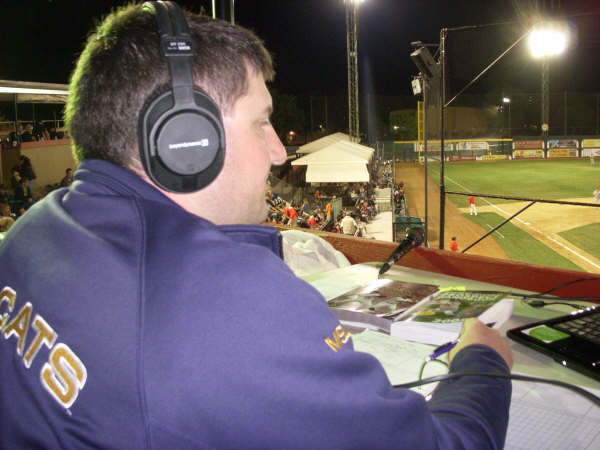
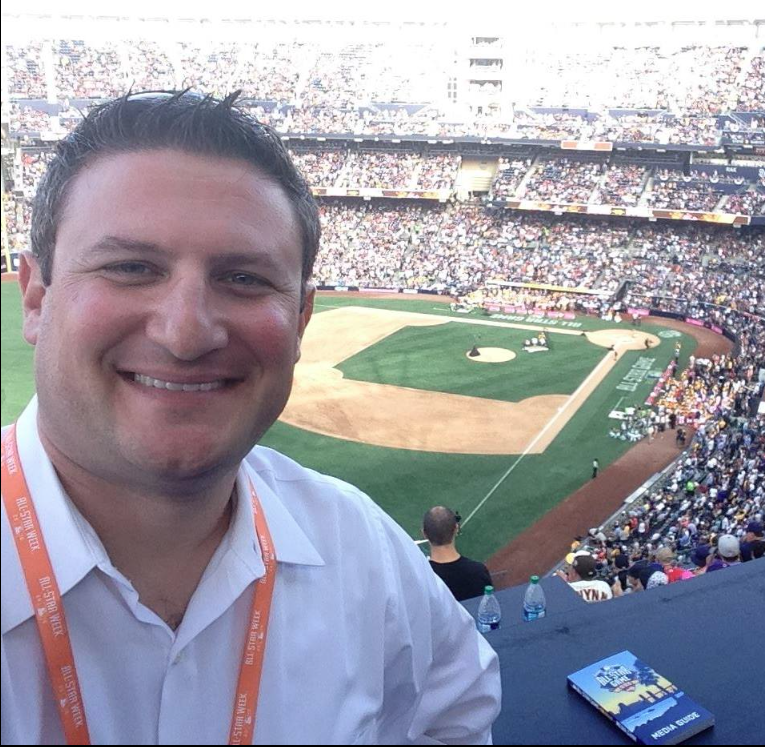
Jeff Lasky gave it six seasons as the voice of the Lancaster JetHawks. During his time from 2006 to 2011, the team was the California League Single-A affiliate for the Arizona Diamondbacks, Boston Red Sox and the Houston Astros. He called games on the local radio affiliate that involved future major-leaguers like Mark Reynolds, Jose Altuve, Jason Castro, Dallas Keuchel and Josh Reddick. There was even Roger Clemens’ son, Koby, who may not have made it to the big leagues, but his dad was often around the park keeping and eye on things and doing interviews.
I enjoyed spotlighting him in a 2009 story for the Los Angeles Daily News as he was on a trajectory up the minor-league chain and getting closer to something bigger, as he picked up more work doing college football and basketball.
“Sure, you’ve got to be realistic about all this,” Lasky said at the time. “The industry can crush your dreams pretty quickly. But the JetHawks have really taken care of me over the years, and I’m getting great exposure on the radio network with the Montana State games.
“In a lot of ways, I’m incredibly fortunate. I think I can make it work.”

In 2011, I included Lasky in a “Tao of Scully” story that attempted to mine information about what broadcasters took away from listening to Scully — some since childhood, as was the case for Lasky.
He had a very interesting response then:
“I’ve had some of my work critiqued by two Triple-A broadcasters in the last few weeks, and both pointed out immediately that they could hear the influence of Vin Scully in my work. It would be impossible to grow up listening to him and not be influenced.
“What I am always amazed by and try to emulate in my own way is how he can engage the listener with his own personality without making the broadcast about him. What I’m still trying to learn from Vin is to make my fundamentals as excellent as possible while maximizing my ability to make a broadcast as enjoyable as possible.
“The challenge is trying to do that without just doing an impression of Vin Scully.”
After he decided to move on from the JetHawks — which sadly became one of the many minor league teams to just disappear after 2019 because of consolidation during COVID — Lasky worked for Fox Sports San Diego covering the Padres. He was on the radio crew for San Diego State football and basketball. Then came an 11-year run as what he said was an “award-seeking journalist” (that’s a Monty Python reference for those in the know) at ABC Channel 10 news in San Diego, doing all sorts of interesting stories in interesting places (see below). And he did win one Emmy Award, which, for those who may not know, can involve paying $250 to actually get the trophy, so … how badly do you want to be an award-seeking journalist?

This past month, Lasky segued into a new career as a marketing and communications specialist for Sharp HealthCare in San Diego.

When I started this Scully book project, I thought Jeff was a prime candidate for someone who could expand on how the Dodgers’ Hall of Fame broadcaster influenced him, and, again, if he was to do a eulogy for him, what would he say? His essay proved to be even more insightful than I anticipated.
As Jeff and I went back and forth on how to craft it further, we decided it might be well to pause it, post it here, and let readers explore how the “Scully Effect” could be problematic for someone in their own career pursuit.
Here is the essay. Let us know what you think:
My children will never have a relationship with a sports broadcaster the way I had one with Vin Scully. I don’t mean a personal relationship, although Vin did inspire me to choose sports broadcasting as a career and though I did get the incredible chance to meet him on two occasions (three if you include the time we both used the men’s room in the Petco Park press box at the same time, but that’s a different story for a different time).
The relationship that I mean is the one that every single one of us who grew up in Los Angeles during Vin’s incredible tenure letting us know that it was time for Dodger baseball. We all had a relationship with him because we were together for so long, each and every day. His voice was always there, calling the game, making us chuckle, helping us know the players. He was with us in our homes, in our cars. I’m just old enough to remember, as a child, sitting in the stands and listening to the broadcast because fans had handheld radios with them at the stadium. Even seeing a game live was better if you could still hear Vin Scully call it.
There are specific memories. I was eight when Gibson hit the home run in Game One of the World Series. I didn’t really know what it meant when Vin said “In a year that has been so improbable, the impossible has happened.” But I knew that it was a poetry that somehow perfectly captured the moment. I remember staying up to watch Vin call a 22-inning game in Houston. Another time, I remember racing into my parents’ room to cheer after listening to Vin call a walk-off home run. Except, it was a school night and I was supposed to be asleep. Fortunately, my parents let me keep my clock radio and I would continue to listen long after bedtime each night, keeping the volume low as to not blow my cover.
There were plenty of other moments I could mention. But the important thing was the presence. He was always there. And even when he wasn’t, I’d pretend he was. I would sit in my room playing baseball video games. If the Dodgers were playing, I would mute my game and listen to Vin. And when the Dodgers game ended, I would simply do my own broadcast of my video game, calling it the way Vin Scully would.
I didn’t know at the time that I was preparing myself for a career as a baseball play-by-play broadcaster. It’s just that baseball wasn’t quite the same without the play-by-play. And Vin wasn’t going to come to my house to call the game, so I had to do it myself.
Of course, it turns out that listening to Vin Scully call hundreds of baseball games throughout my childhood was pretty darned good training to become a professional sports broadcaster.
When I went to a sportscasting camp for a week the summer I turned 15, I was treated as somewhat of a wunderkind. They brought in pros to critique us. One told me he was going to be tougher on me than everyone else, because I really had a chance to make it. But though I must have had some natural talent for broadcasting, it wasn’t like I really knew what I was doing. I was just emulating what I had grown up hearing. I sounded good because I was raised on broadcasting greatness. I was raised on Vin Scully.
It wasn’t until I got a chance to call games more regularly on the student radio station in college that I really started to appreciate play-by-play as a craft. I left Los Angeles for Arizona State University. I was exposed to more broadcasters, and to a group of fellow students from around the country who had not been raised on Vin Scully. They extolled their own favorites from home. But the more I heard and the more I paid attention, the more I realized that yes, Vin Scully was far and away the best.
So I tried to analyze why and implement those answers into my work. What did he do well?
First, his fundamentals were sterling. You always knew exactly what was happening on the field, even if you were listening on radio. You knew the score. You knew when the pitch was being delivered. When the ball was put in play, he was right there with the action, giving a sharp, accurate, and descriptive call of each play. He didn’t scream over routine plays; he was conversational, he was talking to you, an individual, not an audience.
Second, his preparation was incredible. Sure, he had a wealth of knowledge and stories from being around for so long. But Vin clearly put in hours before the game studying up on each team, on each player. And it wasn’t just their stats. It was their personalities, their interests, their hobbies. Whether they were playing for the Dodgers or the opponent. Or maybe something came up that reminded him of players from decades earlier. It’s how I still remember to this day that Satchel Paige would call people “Wild Child” or that Jason Marquis had a watch collection. Vin was clearly prepared for how to make every game, every inning, every at bat interesting.
So yes, he had stories, but boy, could he tell them. In that conversational style, it just came across so naturally. He was just a master. How he sets up his classic tale of how the Brooklyn Dodgers players handled the death threats being sent to Jackie Robinson. The pay off with Gene Hermanski’s solution that they would all just wear No. 42 so anyone planning to be an assassin wouldn’t be able to tell which one was Robinson. And the story about Marquis and the watches just floored me when I heard him tell it over the radio (must have been the first three innings, which were simulcasted) when I was listening while driving on the 57 somewhere near Pomona. Any other broadcaster, me included, would have said something like “Jason Marquis has an interesting hobby. He likes to collect watches.” How did Vin start the story? “Say, if you ever meet Jason Marquis, make sure you ask him what time it is.” Just brilliant.
Those traits became my blueprint. Broadcast like I’m having a conversation with someone, not announcing things to them. Use strong, active, diverse language to describe the play — make sure that my listener could close their eyes but still be able to picture exactly what’s going on. Spend hours preparing for every broadcast. Look for stories, not just stats. Look to entertain, while not distracting from the game.
My first job out of college was the television news sports anchor for a tiny station in Bozeman, Montana. Any chance I had to practice play-by-play, I took it. College sports. High school sports. Even American Legion youth baseball games. During the summer, I’d drive a few hours to Helena or Missoula, where they had Rookie Ball minor league teams. I’d sit in a corner of the stands and record myself, pretending I was doing a broadcast.
Eventually, I put together a CD of my material and began applying for play-by-play jobs. Not only was I hired, it was back in Southern California. In Vin Scully country. I did a season as the middle innings broadcaster in San Bernardino, then was hired to be the primary voice of the Lancaster JetHawks, the only Minor League team in Los Angeles County.
It was during this time that I first got to meet my broadcasting hero. When our local sports columnist in Lancaster, a very nice man named Brian Golden, found out I’d never met Scully, he took it upon himself to drive me down to Dodger Stadium on a JetHawks off-day to introduce me. The moment was brief. A quick hello in the press box, long enough to tell him what an honor it was and how much he had meant to me and my career. A gracious thank you and then it was over — he had a broadcast to prepare for. And the next day, of course, so did I.
It was flattering when our fans would tell me I reminded them of Vin Scully. Since they were Los Angelenos, they knew how a game should sound. So the compliment they were giving me was that I was doing the job the way it should be done.
However, sometimes when my work would be critiqued by other broadcasters; or, more importantly, by those in a position to hire me at a higher level, they would sometimes mention that I sounded like Vin Scully in a way that was not meant as a compliment. It was a criticism that perhaps I was simply impersonating Vin Scully.
I always bristled at that. I had worked hard to find my own voice over the course of thousands of hours on the air and would never simply try to do an impersonation. I tried to emulate what was great about his style, but with my own personality.
Odds are you’ve never heard of me, so you can probably guess that I haven’t ended up calling the game of the week on ESPN, or Fox, or for the Dodgers. After six seasons in Lancaster, I was told the new owners were eliminating the Director of Broadcasting & Media Relations I had held, and would instead turn the broadcasts over to an intern making $500 a month. Our wonderful General Manager told me he wouldn’t insult me by asking me to work for that, so I found myself without a job for the summer. I took advantage by spending the summer with my girlfriend, then living in San Diego, whom I had so rarely gotten to see during baseball seasons. Once there, I quickly got hired at a local sports talk radio station, doing scoreboard updates during Padres games, sideline reporting for San Diego State football, and calling the occasional high school game. I also picked up some freelance work doing feature stories for the magazine-style shows that would air the Padres cable channel before games.
In that capacity, I met Vin a second time. The movie “42” was coming out. The Dodgers were in town playing the Padres that weekend and I had an idea to do a story with Vin and legendary Padres broadcaster Jerry Coleman sharing their stories about knowing Jackie Robinson personally. I figured Jerry would agree – he was always great about sharing a few minutes for an interview. I figured Vin would never do it. He was there to work, and besides, there were never-ending requests for his time. But much to my shock and delight, the Dodgers notified us that he agreed. Which is how I found myself sitting in the visiting television broadcast booth at Petco Park with my career hero, asking questions and hearing that unforgettable voice answer with a series of incredible stories. My piece turned out great. My only regret is that I was too professional to “fanboy” and ask for a picture with him afterward. And the way the booth was set up, there was no way for our photographer to get a shot of both of us together during the interview. So despite the lovely chat, I have no picture of me and Vin Scully together.
I was rarely doing play-by-play in San Diego, but I was working in sports broadcasting in a major media market. Yet, more important things were happening at home. Rarely having to hit the road for work, my girlfriend and I were finally able to have a life together. I could see marriage and children in the future, but that life would be incredibly difficult if I continued pursuing baseball broadcasting jobs that would take us to who knows what town so I could spend half the year riding buses to cheap motels. So when I was offered a job as a news producer in town, I took it. Ten years, a beautiful wedding, and two amazing children later, it was clearly worth it. I always knew I had to find my own way and could never be Vin Scully, and I was right and so I did.
Now, while I still cover sports on occasion for the evening news, I watch most of my games as a fan. I can’t help it — I’m constantly critiquing the broadcasters. There are still a few great ones. Some, you’re even reading essays from in this book. But I find the vast majority to be pretty mediocre. Professional, yes, Passable in a forgettable sort of way. Not especially interesting. So few even bother with attempting the style that Vin Scully developed so well.
It’s a lot more difficult than just spewing the same sports cliches over and over. It takes a lot more work to research great stories about the players rather than just read the stats handed to you in the press notes. But just because none of us can do it as well, doesn’t mean it’s not worth striving for.
I get it. Scully made it look easy, despite being unbelievably hard. But until more young broadcasters study what made Vin great and find ways of reflecting that in a modern broadcast setting, I’m afraid my children will just tune out the game broadcasts, rather than have the rich connection a young boy, then aspiring broadcaster, then working professional, now once again just a fan, had with that voice. They won’t have a relationship like the one I had with Vin Scully.
*****
In the weeks that I corresponded with Jeff, talking about how the piece might be edited and focused leading up to a June 1, 2023 deadline, here are some of exchanges:
Jeff, on May 4: I’m certainly flattered to be asked. I have so many of those little personal connections that so many of us who grew up in Los Angeles have to Vin. I still have the autographed ball that a friend gave me for my birthday in 6th grade. And I’m not one to ascribe coincidence to divine providence, but for all that Vin meant to me, would you believe that at the moment he signed off for the final time, I, having already been a San Diegan for several years, just happened to be driving on the 5 right underneath Dodger Stadium? I realize the team wasn’t there — the game was in San Francisco. But I was glad to be in that spot at that moment, tearing up behind the wheel. This clearly feels to me like I’m trying to warm up to writing something for you. I just don’t know how interesting it would be to people.
My response later on May 4: I was also wondering, when I sent you the quotes that you had given me in 2011, as you were talking about how some of those critiquing you said you sounded like Vin, did you consider that a compliment or did it put pressure on you? Was it a blessing and/or curse to have him in your head growing up? Ultimately, did he inspire you to try to do play by play?
Jeff, on May 5: That’s a complicated question, that I may not even fully understand the ramifications of, to be honest.
When JetHawks fans told me I sounded like Vin, it was absolutely a compliment. To me, how he called a game is how baseball should be called. Lancaster is in Los Angeles. Those fans also listened to Vin Scully. So when they told me I reminded them of him, I took that to mean I was calling the game the way it was meant to be done, if that makes sense.
However, when I would have my work critiqued by other broadcasters, sometimes I almost felt like the Vin comparison came as a kind of warning, like they felt that because I emulated Vin stylistically, that I was doing an impression. Did I feel more pressure? Not at all. But when that comparison would sometimes be leveled as a criticism, I would bristle, because I never felt like I was doing an impression. I couldn’t be Vin Scully. I never tried to be Vin Scully.
But I absolutely wanted to do a fundamentally sterling, strong descriptive, conversational, personable broadcast that didn’t shy away from telling stories. There’s no way it can be a curse to get to grow up hearing a game called the way it should be. He was absolutely inspirational. But I almost feel as if Vin Scully was considered by some broadcasters to be so uniquely great, that anyone who sounded inspired by him was discounted a knock-off instead of judged on their merits. I worry that perhaps there were people doing the hiring who listened to a few seconds of my reel and said “eh, he’s trying to be Scully, forget it” without fully realizing my quality as a broadcaster in my own right. Then again, maybe I wasn’t as good as I thought I was. After all, I didn’t get hired to move up. I almost got a job in AA at one point.
When a chance came up to make a salary I could start a family on by switching to news, I took it. I can’t imagine doing the minor league thing now. The travel, the buses, the motels, leaving my family. No, thanks.
I just wish more broadcasters actually tried to emulate Vin’s style in their own voices. Ninety percent of sportscasters sound the same. Cookie cutter. Same type of voice, uninteresting, no stories, filled with cliches.
I circled back on May 21: So after pondering any and all of this complicated issue, I was wondering what you thought? What was it like to be compared to Vin when you were in the broadcasting career path? Was it a double-edged sword?
Jeff submits an essay on May 23 and adds: Sorry, got sidetracked with multiple other projects I’m working on in the evening after I get the kids to sleep. You gave me a gentle kick to get me to finish a draft. It’s only twice as long as you wanted. Writing essays isn’t something I do much, so let me know if it sucks. Hopefully, it’s at least a different perspective from all the luminaries you have in the book.
My response later on May 23: Thank you for this.
I understand the wheelings and dealings of a young family and can appreciate how it must be to revisit something like this — you were set up to succeed in an area you were told you could succeed, and things happened that didn’t make things happen out of your control. If I hadn’t thought you had the talent and personality to pull off a PxP career I wouldn’t have invested my time and words to trying to make others see it as well. I hope I didn’t add to expectations that weren’t necessarily fulfilled. That said, you had a great run, and you found what was your priority. You won’t regret that choice of wife/family/security/stability.
Your honest, open essay here is really compelling. Let me think about this awhile (which, really is until the end of the week because the book is due June 1). I don’t want to dismantle it for the sake of space. I can extract a good part of it as sort of a Scully-related aspect of what happens when one gets compared to Scully.
I keep thinking how Vin’s advice to you, and anyone, would focus on two things: He never listened to any other broadcaster because he trusted this was who he was and he didn’t want to be influenced by someone else, and he always trusted himself.
That’s easy when you are as good as he was, but even he needed at least all those years in Brooklyn under Red Barber to hone his craft (some of the essays will explain that) and then take a leap of faith to move to L.A.
Maybe the best thing is to hang onto this essay and find a way to use it as a teachable sort of moment. This creates a great discussion that runs almost parallel to the book’s intent and direction.
One of the essay contributors offered to do a podcast after the book comes out, to actually talk with the contributors – get some of their voices on things that didn’t fit into a tidy essay. Again, for what it’s worth, I think I saw your talents (based on what I know as a guy with a keyboard and listening to baseball) and wanted to be proactive writing about you for the readers. The fact they let you go, and the team disappeared, is the past. You’ve got the foundation if a job ever opened up and could stay local to a large degree. Experience matters. So let’s see where this takes us.
Jeff, on May 30: Thank you for your kind words, and all that support back in the day. It was very meaningful then and remains so now. Life is good and I honestly can’t imagine now being 42 and still riding buses all the time to stay in dumpy motels, so I may have had a shelf life anyway. And though I miss calling the games and some of the relationships, I don’t miss the rest of it. I’m sure my essay is a weird fit, too long and filled with fluff anyway. So whatever you need to do with it, go ahead. Keep in touch and let me know what happens!
I concluded on May 30: Hey Jeff: All’s good. As I’m wrapping up the last days of the book before it gets shipped off, I think it is best to put your essay off to the side and see how we can use it going forward in other ways to talk about Scully’s influence. I don’t want to water it down shorter because I think it needs the length to add context. I don’t sense conceit at all, just a great perspective.
******
Before Jeff Lasky, there was Mike Saeger. But not that much before.
In 1995 — almost 10 years prior to Lasky starting his broadcasting journey — the Los Angeles Times’ Steve Henson wrote a piece titled “Talking a Good Game : Scully Sound-Alike Saeger Paying His Dues as Voice of Spirit.”
It was about another young man, also with ties to Northridge, who had the dream to be a baseball broadcaster, because that’s what he fell in love with growing up. Listening to Vin Scully.
Henson’s piece about the broadcaster who just started at the Dodgers’ San Bernardino Spirit minor-league team included this:
Legions of Angelenos have been soothed on a summer night by Scully’s play-by-play, Mike Saeger among them.
And he didn’t set out to sound like Scully. He just does.
Saeger, 28, is the play-by-play announcer of the Spirit, a Class-A team broadcasting its games for the first time. He grew up in Mission Hills, attended Kennedy High and studied his craft at Cal State Northridge, calling Matador baseball and basketball games in the late ‘80s to a nearly nonexistent audience on KCSN.
“Ever since I can remember I was re-creating football and baseball games in my room,” he said. “I’d watch Dodger games and talk out loud. My parents probably thought I should be committed but I was planning my future.”
It is a future with few guarantees. Like the players he describes, Saeger toils in the bush leagues, working for low pay in an obscure town. For every Vin Scully, there are several dozen Saegers and a hundred trained broadcasters muted by unemployment.
Saeger appears to have big league potential — his preparation is meticulous and, heck, he sounds like Vin Scully — but he knows that openings at the top are few.
“The odds are always against you,” Saeger said. “Everybody in the game is facing the same odds. But I’ve never thought about not making it. I figure if I plug ahead, I’ll get there.” …

“He’s amazing. He does a great job and is adding a new dimension to these games,” said (season-ticket holder Chuck) Galusha, craning his neck to peek at Saeger in the press box at a recent game. “I keep looking at him. I’d swear I was listening to Vin Scully.” ….
The station that broadcasts the games, KMEN-AM 1290, has not yet calculated the number of folks who tune in. But Saeger gives those who do the feeling that their local affiliate is just that — affiliated with the Dodgers. Call it a Vin-Vin situation.
Although not a Dodger employee, Saeger is in his third season as the announcer for a Dodger affiliate. He was the announcer for the Vero Beach Dodgers of the Class-A Florida State League the past two years.
Whether this will help when the inevitable day comes that Scully retires is entirely another matter.
“The Dodgers believe in promoting from within, they’ve always been good that way, but there would be so many people applying,” Saeger said.
Saeger hasn’t met Scully, and figures he probably won’t. Not this season anyway.
“I know a few people in the organization,” he said, noting he and Dodger assistant publicity director Derrick Hall worked together in Vero Beach. “But meeting Vin Scully, that would be tough to happen.”

So, then, what became of broadcaster Mike Saeger?
In 2006, almost 10 years after that LA Times story, he expanded his resume when he helped launch Cal Baptist University’s digital media, and was the first play-by-play voice for NAIA Lancers men’s basketball.
By 2008, he was recognized for having called 2,500 games in the minor leagues.
He ended up spending 15 years in San Bernardino and got a promotion — to the San Antonio Missions, then the San Diego Padres’ Double-A team, in 2010. In ’19, the team moved to the Triple-A level — one stop from the big leagues.
Then came the pandemic, and the reorganization of the minor leagues. Contraction. Saeger’s run in San Antonio lasted 10 seasons, through 2020, and when he left, the team was reassigned back to Double-A again in 2021.
Saeger is on a new mission. With a new spirit.
For the last three-plus years Saeger has been with VP Racing Fuels, a company involved in race fuel technology, heading up its website marketing since 2021. He is putting his corporate sales and media marketing skills to work — as well as his storytelling abilities that he also developed in San Antonio as a broadcaster.
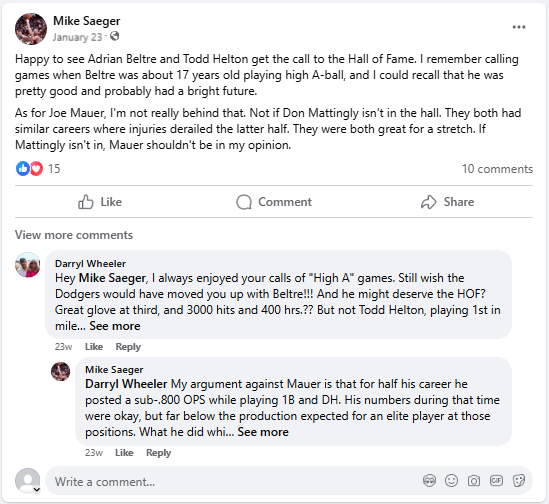
I caught up with Saeger and through more email exchanges, he explained how Lasky was someone he once hired as his broadcast intern in San Bernardino, and how proud and happy he was that Lasky had a nice career run in broadcasting.
Saeger continued:
I can very much relate to what he wrote in his essay. There are quite a few parallels. Like Jeff, I was a Scully disciple and very much under his hypnotic spell (and I mean that is a compliment).
Having Vin as my companion and soundtrack to summer for so many years growing up, my only analogy would be someone who was sitting there during the writing and composing of Mozart’s Requiem. It was simply something you’d never heard before.
Vin was THE reason I became a broadcaster. I knew I wanted to broadcast baseball from about the time I was 7 years old, and that was because of Vin. I had no idea how I was going to to do it or what I needed to do to do it, I just knew that’s what I was going to do.
One of the biggest thrills in my life was receiving a letter from Vin when I was maybe 13 years old, plus or minus. I had written him telling him what a great influence he had been, and asked him if he had any tips for a young aspiring broadcaster. He actually wrote back. One of the things I remembered most from that letter, which I still have somewhere, is he said if you ever get an opportunity to broadcast, you bring something unique to the booth that no one else has: your own personality. In other words, be yourself.
Early in my career I sounded a lot more like Vin than I would have liked. I think it was simply a byproduct of growing up listening to him for so many years. Just like Jeff said, I got a lot of compliments from people, but I also had folks in the industry who pointed that out. I know their critiques were not meant as a compliment.
It took a number a years and a very conscious effort to try to not sound like Vin while maintaining his style, which is what made him so unique among broadcasters. Talking to the listener instead of at the listener. Being descriptive. Not overdoing it with stats. Weaving interesting anecdotes in a natural way throughout the broadcast, etc.
My view of broadcasting was that I was majoring in journalism with a minor in entertainment. That’s really what broadcasting is.
I remember once getting a handwritten postcard from the former wife of Jerry DaVanon, who is a former big-league player. Their son, Jeff, was playing in the minor leagues at the time, and she caught some of my broadcasts when we were playing against his club. In her letter, she mentioned that she had heard hundreds and hundreds of broadcasts and broadcasters during her time while being married to Jerry, and she said I was one of the best broadcasters she had heard. That was probably the most impactful letter or email I had ever received because it was unsolicited and at the time, it validated what I was trying to do.
If I had grown up in any other city, I can’t say for certain that my goal would have been to be a broadcaster. Maybe it would have been. We’ll never know.
I will still occasionally turn on an old Dodger radio broadcast on YouTube when I have nothing else going on. It’s not so much to listen to the game as it is to hear Vin. I have a myriad of childhood memories that are attached to Vin and his broadcasts with the Dodgers. That’s also part of the allure. Hearing his voice taps into some really happy times when I was young, going to games with my grandfather or sitting with him in his house listening to or watching a Dodger game.
Funny story about that: he lived in Toluca Lake and he and my grandmother were very musically inclined. He was involved in show business on a very local level. I remember recreating a baseball broadcast, though I don’t remember how old I was — I was pretty young. I had recorded commercials from a Dodger radio broadcast on a cassette tape. I recruited him to play the organ so I could have the National Anthem, the “Charge!” theme, and the 7th inning stretch for my make-believe broadcast. I recorded my play-by-play using the recording equipment he had in his house. Then I edited in the commercial breaks and his organ music. It wasn’t studio-quality editing, but it got the job done for however old I was at the time. My grandfather was the greatest influence on me among anyone I have personally known, and we both shared a love for the Dodgers and for Vin.
I did have a chance to meet Vin once, and it was fairly brief, when I was doing a radio feature piece in college. The feature was about the Dodgers Think Blue week, which was a pretty big thing back in the ’80s. I had gotten a press pass, and had interviewed Bill Russell and a couple of other people for my radio feature. When the game ended and Vin was exiting the booth, I courageously walked up to him, introduced myself, reminded him of the letter he wrote me (which I know he had no recollection), and we chatted for maybe 3 minutes. He was very kind and gracious, as he was with everyone he met.
When it comes to most broadcasters today, I agree with what Jeff wrote. There are a number of fine sounding broadcasters out there, but there’s really no one that I would intentionally stop to listen to. The art of storytelling has pretty much gone the way of the dodo bird. I would stop to listen to Vin read a phone book (and he actually did read a grocery list as a lark for a radio station back in the late ’70s. You can find it on YouTube. It’s a thing of beauty).
Not only did he have a remarkable command of the English language and was well-studied and well -read, he had an impeccable sense of timing. If you’re a baseball hitter, they say timing is of utmost importance. To be successful, you have to be on time to the ball. Scully was always on time in his broadcast. He never missed a play. He could naturally weave a story within the flow of a broadcast, pause to let you know what was going on with the play, and then continue smoothly in a way that you wouldn’t even really notice. And he was always on time.
I listen to a fair amount of radio broadcast today, and I constantly hear broadcasters who miss a pitch or are late on a pitch. You’ll hear the crack of the bat and a ball might have gone foul into the left field stands, but the broadcaster is either late to acknowledge it or never acknowledges it because he’s in the middle of talking about something else, and then just picks up with the next pitch, like “last pitch was fouled off, and now the 2-2.” That annoys me like no one’s business.
There is really nothing unique about any of the broadcasters today, and that is sad. That’s not to say there aren’t some good broadcasters. There’s just nothing really unique about them. But I think that’s also a byproduct of the times.
Vin learned under Red Barber. Barber was a southerner. Ernie Harwell, another legendary broadcaster, was also a southerner. Many of the early great baseball broadcasters were from the south. Storytelling was a big part of the southern culture, at least back then. I don’t know if it’s that way today or not. I think that’s why so many of the older generation of broadcasters were exceptional storytellers. Sadly, radio is no longer the main medium for following baseball. Many broadcasters today talk in sound bites. There’s very little ( if any) storytelling, just commentary on what’s happening in the game — which is important because the game is the priority — but it’s like listening to a great piece of music in mono instead of stereo; it’s just not as fulfilling. Vin sucked you in like a black hole. When you were in the vicinity of his voice, you had no chance. And you didn’t want to have a chance.
He was so humble and so genuine it almost didn’t feel right. It’s like, wait, you’re the greatest of all time. You can stick your chest out. You can put on airs and anyone would understand. But he didn’t, and you knew that was who he really was. Just a kind, caring, gentle soul, who loved what he did and honestly appreciated the opportunity he was given. He might be one of the least pretentious people who has ever walked this earth, and that’s not hyperbole.
I’ll be forever grateful that I had nearly 50 years listening to the maestro of broadcasting — watching the broadcasting version of Michelangelo paint the Sistine Chapel — and because of him, enjoyed a 30-year run in the industry.
I followed up asking Saeger if that 1995 story in the L.A. Times affected his career arch — did it help, hurt or somewhere in between having a major newspaper like that compare him to Scully. Saeger responded:
I didn’t feel it put any pressure on me, at least none I recall. In fact, I thought the opposite. I was hoping that some exposure in a large newspaper might help me at some point. Perhaps someone high up somewhere would read it and be intrigued, or at least remember my name.
I can’t say it helped my career, nor can I say it was a detriment. I thought Steve did a really nice job with the piece, I was happy with it, and I was grateful that he had enough of an interest to want to reach out to me to write it in the first place. I still have that article sitting around somewhere in the house. My mom saved stuff like that and eventually turned it over to me.
The funny thing is when I would listen back to some of the games I recorded at the time in order to critique my own work, which most young broadcasters do on a pretty regular basis, I didn’t really hear a lot of Scully. But I had heard it enough from others during the early years of my career, I believed it must be so.
So I took it upon myself to try to change.
But it was a gradual process, not something you’re able to do by just flipping a switch. I think there was always a little bit of Scully still there, but at least it became less pronounced as time went by (at least I thought it did). I had never consciously tried to sound like him.
*******
Several essays in “Perfect Eloquence” from broadcasters in the final chapter who admit that growing up in L.A. with Scully was their greatest influence — Brian Wheeler and Mike Parker, in particular — have ended up experiencing nice, fruitful careers in the broadcasting business, taking advantage of a break here and there, being available to step when there was an opening, having prepared for that moment and maintained their health and commitment.
For every success story there might be, we also think about those who, for whatever twist of fate, weren’t fully able to launch into a life-long career of broadcasting — but they retained their love of storytelling and preparation, remained humble and purposeful, and kept their professionalism.
That, in the end, is something very the residue of the Scully Effect.
 Perfect Eloquence: An Appreciation of Vin Scully
Leave a comment